AI won’t rescue Sub-Saharan Africa — further economic divergence is the default
A child born in Lagos today will live longer and learn more than her parents. She will also fall further behind a child born the same day in Jakarta or Hanoi.
AI kills Sub-Saharan Africa’s best shot at catching up
Manufacturing used to be the only reliable path from poverty to prosperity.The exceptions are resource-rich countries like Qatar. Manufacturing is a ladder: countries to go from sewing garments to producing chips. Firms make more complex, higher-value products; workers grow more productive. India and the Philippines have recently pioneered an alternative ladder — exporting services.
Manufacturing has never taken off in Sub-Saharan Africa (SSA)See for example Dani Rodrik, “Premature Deindustrialization,” Journal of Economic Growth (2016)., with the exception of South Africa and tiny Mauritius. For a while it looked like Ethiopia might follow them, until it descended into a civil war. Even before the war Ethiopia’s flagship industrial parks only employed ~90,000 people in 2020, a rounding error in a workforce of ~55 million.Figures from the Ethiopian Investment Commission, the government agency that runs the country’s industrial parks. Cepheus Capital, an Addis Ababa-based investment-research firm, counted 71,000 workers across the ten then-operational parks in 2019–20; the World Bank put the total at about 88,000 across all 14 parks on the eve of the pandemic in early 2020. See Cepheus Capital, “Ethiopia’s Industrial Parks: A Data Pack on Recent Performance” (September 2020); and World Bank, “Firms in Ethiopia’s Industrial Parks: COVID-19 Impacts, Challenges, and Government Response” (September 2020).
SSA’s best hope for moving beyond exporting commodities was becoming the world’s call centre and back office. AI takes that hope away — and with it the bottom rung of the only ladder SSA had left.
There are few jobs for AI to take in SSA
Unlike the West, SSA has few workers doing the kinds of “low-skilled” tasks using computers that AI could take over first.
Outsourcing — call centres, back-office work, basic IT — currently employs only about a million people across all of Africa.The figure is a research estimate from the Mastercard Foundation’s 2025 report Powered by People, Enabled by AI: The Future of Africa’s Outsourcing Sector. Of course, it has even fewer “high-skilled” knowledge workers — tech founders, scientists — who stand to gain the most from AI.
Only a small portion of SSA workers have what we’d recognise as jobs — with a written, formal contract. Half of those jobs are in the public sector.
The vast majority of workers are stuck in low-productivity occupations: smallholder farmingWith the right policies, smallholder farming can be a foundation — perhaps the foundation — for long-term development, as best demonstrated in East Asia. See Joe Studwell, How Asia Works. and non-tradeable services. These services can’t be exported and earn dollars — think street hawking or hairdressing.
Here is a breakdown of what SSA workers do. Mind you the data is likely highly inaccurate because SSA states tend to … not actually collect the data (but still report numbers). Whenever I see SSA economic data I treat it as “probably directionally correct”. Same with population counts.For an introduction to the problem, see Oliver Kim’s book review of Morten Jerven Poor Numbers: “How Much Should We Trust Developing Country GDP? A Review of Morten Jerven’s Poor Numbers, A Decade On”.
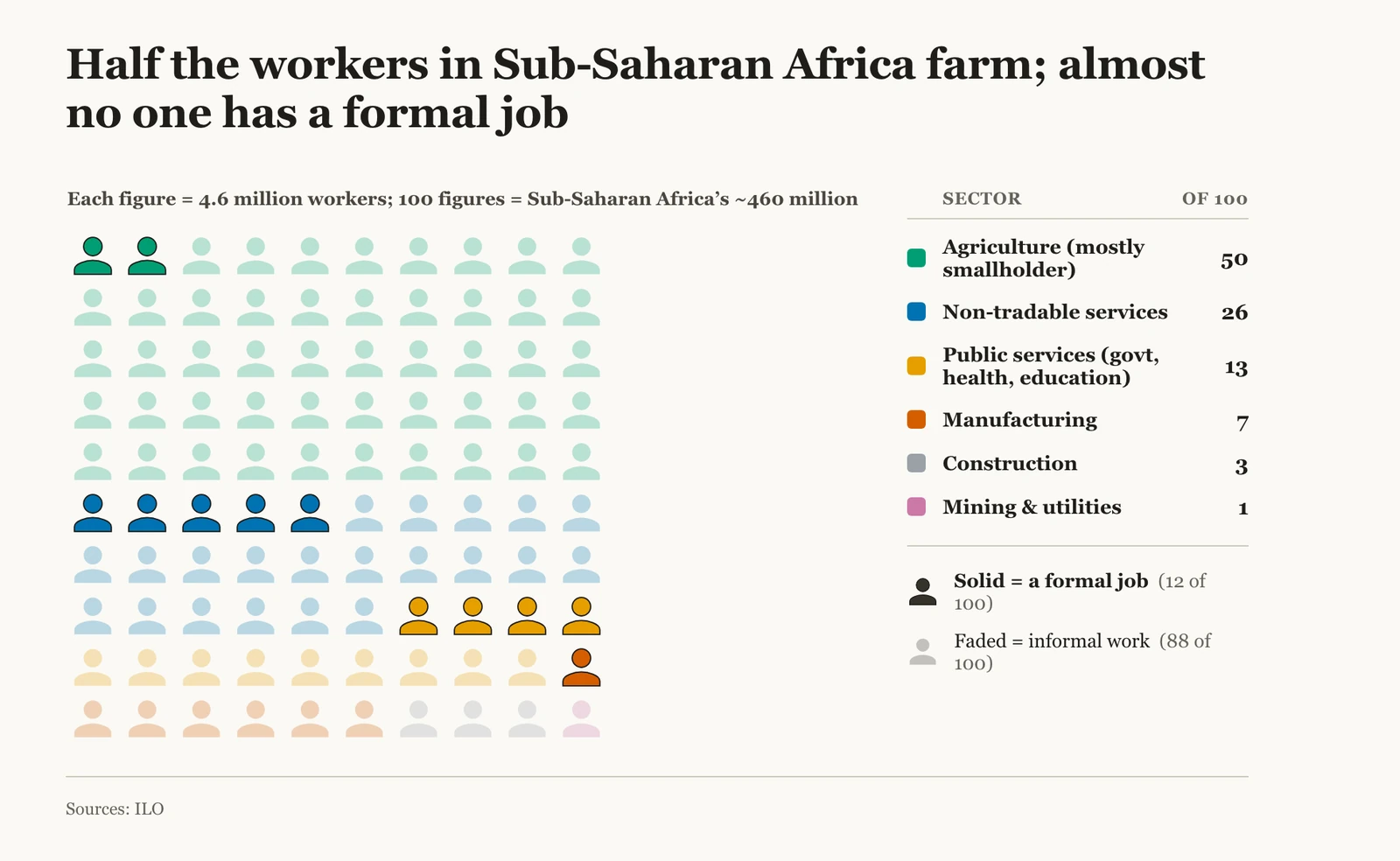
Job creation hasn’t kept up with the steep population growth. About 15 million people join the workforce every year. Only about 3 million land a job with a regular paycheck.ILO (the International Labour Organization, the UN’s world-of-work agency), Employment and Social Trends 2026 (14 January 2026): Sub-Saharan Africa’s labour force grew by 15.4 million between 2024 and 2025. Only about a fifth of the region’s jobs are wage-paying (World Bank, Africa’s Pulse No. 32, October 2025), so barely three million of those entrants can expect a regular paycheck. Barely one in ten jobs is formal (a written contract with social protection); nearly nine in ten workers are informally employed. Even if the fertility rate collapsed today, the number of workers would barely budge before 2050.
On AI diffusion, SSA is not in the race. Little job loss, little chance of a boom, little chance of turning AI into a new developmental ladder.
Oil, aid, remittances — and why none of it is safe
What happens to countries not on a developmental ladder? The dollars still come in: from commodity exports, aid, remittances. But these countries never get to learn — never get better at making things. Commodities are prone to price shocks and substitution, remittances can be taxed at source, aid can be cut.Learning in low-complexity manufacturing seems to be particularly efficient. See Dani Rodrik, “Unconditional Convergence in Manufacturing,” The Quarterly Journal of Economics 128, no. 1 (2013): 165–204. Unless SSA builds economies that make things the world will pay for, its access to dollars stays fragile.
SSA exports are concentrated in a few commodities and stand little to gain or lose from AI
In 2024 SSA countries exported $520 billion — slightly less than Belgium, a country of 12 million.
Strip out South Africa — the only industrialised SSA economy — and the exports drop to $392 billion — a quarter of SSA’s entire export economy is just one country.
Contrary to popular wisdom, SSA is not resource-rich. It only looks like it is because natural resources dominate exports, foreign direct investment — and Western reporting. All of sub-Saharan Africa — 1.3 billion people — earns about as much from its oil, gas and metals as Australia does with 27 million.~$245bn of fuel, ore and metal exports (World Bank/Comtrade, 2023) vs Australia’s ~A$415bn / US$270bn (Australian Dept. of Industry, 2023–24). Across Africa’s thirteen genuinely resource-dependent states, the minerals and oil still in the ground come to a median of just $3,300 a person — and in the Democratic Republic of Congo, the continent’s supposed mineral treasure-house, only $350.Michael Ross & Eric Werker, “Diversification in Resource-rich Africa, 1999–2019,” Resources Policy 88 (2024). Per-person endowment = total minerals and hydrocarbons left to extract — a reserves measure that doesn’t lean on Africa’s unreliable GDP data. It does lean on the equally unreliable population data, however.
Data centres use Congolese cobalt and Zambian copper. But that won’t win Kinshasa and Lusaka access to the frontier model of 2028. Cobalt is being designed out of batteries, and the copper market is global and diversified.
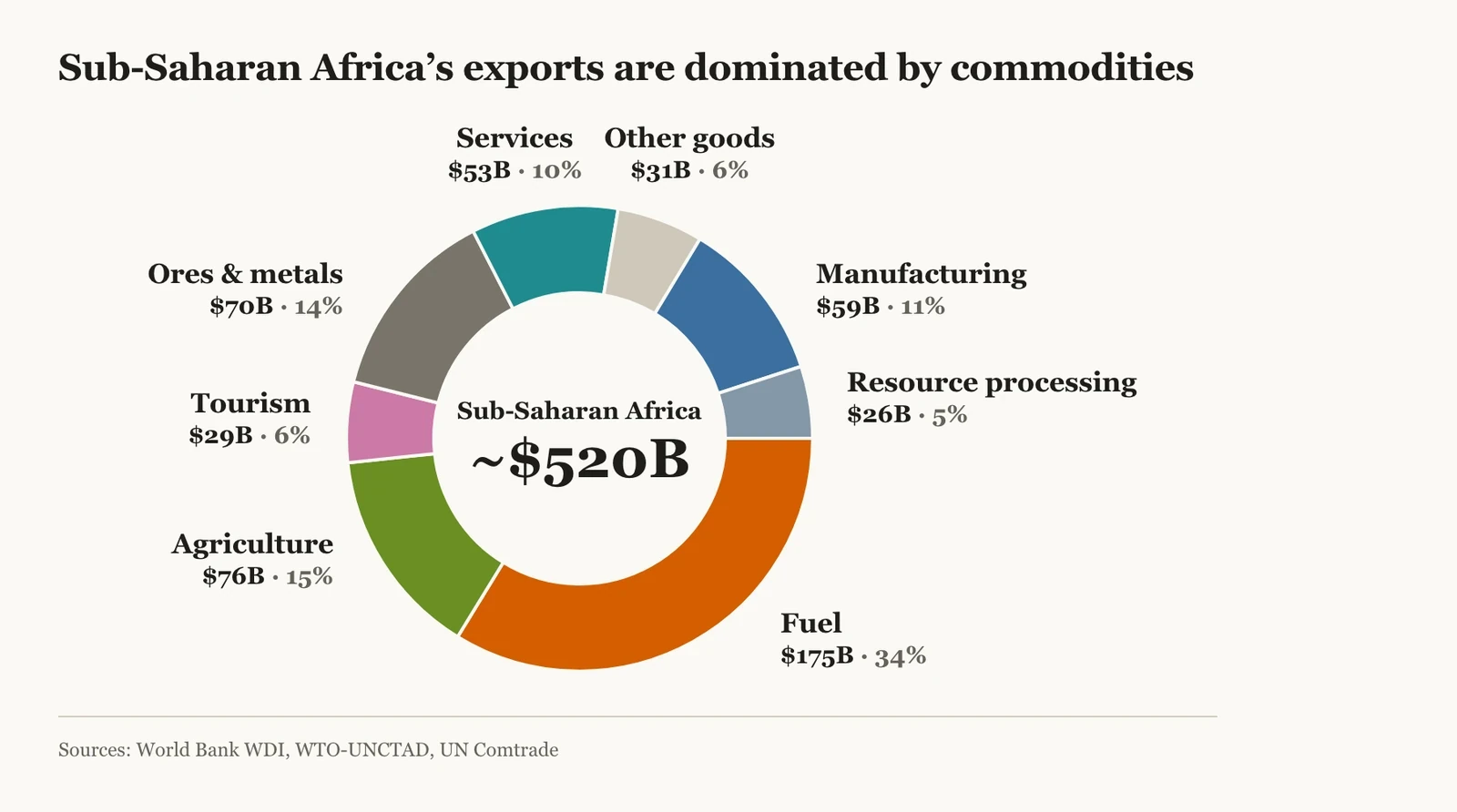
So what are the actual threats facing SSA’s biggest exports?
Fuel
Oil revenue could crater even if advances in solar, batteries and synthetic fuels don’t end up “replacing” oil. West African oil is more expensive to produce than the Gulf’s — so when prices soften, West African fields are first to go undeveloped.
Angola lost half of its output between 2010 and 2025, and its revenue never recovered. Even when oil prices climbed back to ~$100 a barrel in 2022 — essentially their 2014 level — Angola pumped about a third less crude (1.65 → 1.14 mb/d) and earned about a third less for it (oil exports ~$60 billion → ~$41 billion), because no price rebound can sell barrels you no longer produce.Sources: the 2010→2025 halving → EIA (Angola produced ~1.9 mb/d of crude in 2010) and World Oil (~1.0 mb/d in 2025, after dipping below 1 mb/d mid-year). The same-price 2014-vs-2022 comparison (Brent ~$100 both years, which isolates output from price): 2022 production + export value → OPEC Annual Statistical Bulletin 2023 (Angola: 1,137 kb/d; $41,241m); 2014 production → EIA; 2014 export value → World Bank. Brent → EIA spot series. Oil is 95% of Angola’s exports and ~60% of government revenue; losses are existential.
Nigeria, the region’s biggest producer, is on the same path. Its crude output peaked at about 2.4m barrels a day in 2005–06, sank to a ten-year low of 1.3m in 2022 and had recovered only to around 1.4m by 2024. The Energy Information Administration, the U.S. government’s official energy-data agency, expects West African output to stay broadly flat through 2050. The clearest signal is who is getting out: Shell, ExxonMobil, Eni and TotalEnergies have all sold their onshore Nigerian fields to local firms, while Equinor has quit the country altogether.Production figures from the Energy Information Administration’s Nigeria Country Analysis Brief, 2025; the flat-to-2050 outlook is the reference case in its International Energy Outlook 2023.
Ores and metals
The force actually hollowing out an African mining economy right now isn’t AI-enabled materials science — it’s synthetic diamonds. We’ve known how to make them for seventy years, but the production has finally become cheap enough to gut Botswana’s budget and help unseat the party that’s ruled since independence.About a quarter of the world’s diamonds are mined in Botswana.
Agriculture
Cocoa is SSA’s single biggest agricultural export — and the one most at risk. In 2024, SSA exported $11 billion worth of cocoa; higher prices in 2025 drove it up to $20 billion. Côte d’Ivoire and Ghana grow close to 60% of the world’s cocoa. Across the two countries an incurable virus is spreading fast; in Ghana alone, roughly a third of cocoa farmland is now infected.Infected trees don’t die at once; they lose a third of their yield and slowly fade over a decade, and the only remedy is to cut them down and wait years for replacements — so most are left standing, declining, and spreading it further.
Almost none of these threats are related to AI. The export economy is being hollowed out the old-fashioned way — by substitutes, disease, and depletion.
Remittances look safe. Stablecoins could change that
In 2023 SSA countries received $54 billion in remittances.Source: World Bank/KNOMAD Brief 40. Having failed to create jobs at home, African politicians are now copying the Philippines and striking bilateral deals with destination countries to make it easier for their citizens to work abroad.
The Trump administration’s milquetoast attempt to tax remittances was watered down from 5% rate to mere 1%.The tax only applies to money orders/cash transfers; anyone with a bank account can avoid it. Crypto is also exempt. The Gulf countries did send many SSA workers home when they weren’t needed during Covid. But most SSA remittances come from the West. While mass deportations are no longer outside the Overton window, it is hard to imagine them making much of a dent in the overall immigrant stock. Fewer new arrivals would mean lower remittances over time; second-generation immigrants tend to send home less.
Stablecoins are the real wildcard: they bypass recipient countries’ central banks. No dollars, no way to pay for imports. If this happens, it could happen fast.
Aid is collapsing
No country has ever got rich through aid alone. Aid doesn’t build out manufacturing and doesn’t execute land reform.The mid-century East Asian land reforms were imposed under American occupation and Cold War pressure. It may even be net-negative; there is ongoing academic debate over whether aid crowds out manufacturing and disincentivises governments from focusing on sustainable development.
In 2024 Western governments gave SSA $36 billion in bilateral aid. Roughly the same amount arrived as ultra-cheap loans from the likes of the World Bank — ultimately underwritten by foreign taxpayers. Government-owned investors put another ~$10 billion into SSA firms, and the UN agencies and global health funds add several billion more.OECD aid statistics, 2023 (bilateral); World Bank/IMF/African Development Bank annual reports, FY2024–25 (concessional lending). In comparison, private philanthropy only channels $3 billion per year to SSA.
The collapse came in 2025. Aid from the rich-world donor club fell 23% in real terms — fifty billion dollars, the largest annual contraction in its history — and its direct bilateral aid to SSA fell 26% in a single year. America’s cut alone was $38 billion.OECD, Preliminary official development assistance levels in 2025, Apr 2026 — US ODA $29.0bn, down 56.9% in real terms; the five largest donors drove 95.7% of a ~$50bn real-terms decline, the US alone three-quarters of it — OECD (PDF). Even the UK, long aid’s loudest champion, has lowered its aid spending target from 0.7% GNI to 0.3%. Even China’s government-to-government lending to all of Africa (not just SSA) has collapsed from $28 billion in 2016 to $2.1 billion in 2024. Angola alone got $1.45 billion.Boston University Global Development Policy Center, “Chinese Loans to Africa,” Policy Brief 028, Jan 2026. Complete withdrawal is unlikely: foreign governments still care about protecting shipping lanes and mining corridors, “denying terrorists safe haven” and counting votes in the UN General Assembly.
How many countries would be viable if foreign governments decided to walk away?
Without a ladder, divergence is the default
SSA economies are not creating high-productivity jobs, and their exports are concentrated in a handful of commodities. As a result, they have been diverging from the other developing countries since the 2000–2014 commodity boom ended. That boom ran on Chinese demand, Chinese loans and big increases in foreign aid. Growth has slowed most in countries that had most benefited from the commodities boom.IMF, “Growth in Sub-Saharan Africa is diverging” (2024).
At current growth rates, per capita income in sub-Saharan Africa would take roughly half a century to double.IMF, “Africa needs a growth reset” (2026).
— IMF
But divergence doesn’t equal collapse. In absolute terms, Africans will likely keep getting better off. Western innovations in medicine, public health and agriculture have already saved hundreds of millions of African lives. Cheap batteries and solar could let SSA skip building the national grid. Cheap Chinese solar-powered water pumps already make up for the lack of irrigation infrastructure. Starlink is bringing the internet everywhere and even today’s free-to-use models are more than capable of finally transforming education.Simply channeling kids into schools doesn’t increase future economic outcomes; quality of education (and other factors) matters too. Lant Pritchett, a development economist, found that the dramatic expansion of schooling across developing countries had no measurable effect on the growth of output per worker — plausibly because the schooling was low in quality, or because it landed in economies that rewarded credentials and rent-seeking over productive skill. See Lant Pritchett, “Where Has All the Education Gone?” The World Bank Economic Review 15, no. 3 (2001): 367–391.
Divergence is not a foregone conclusion
On current trajectory, with SSA unable to produce its way to convergence, the only (half-credible) path to preventing further divergence is a massive increase in aid. That seems unrealistic today, but many younger people in the West would readily agree with statements such as “all human lives are equally important” and “a person is not less deserving of support just because they don’t live in the same country as me”. These also happen to be central beliefs of the Effective Altruism movement which has shaped the worldview of many billionaires-to-be courtesy of the OpenAI and Anthropic IPOs. Those billionaires will be influencing policy if and when the US starts growing at 10% per year.
Being able to receive aid and transform it at least somewhat efficiently into welfare requires peace. The more state capacity you have, the more aid you can procure.Joe Studwell, How Africa Works. Donors reward delivery: the aid agencies “delivered support to each of Africa’s early outperformers — Mauritius, Botswana, Ethiopia and Rwanda — far in excess of what they should have received based on population,” because the recipients “made good use of the funds” (ch. 10). Rwanda is the extreme case: “Rwanda has received more aid per capita than almost any other African state” (ch. 7). As a Botswana official recalled of an earlier era, “the aid donors actually queued up as Botswana’s reputation for spending money as planned increased” (ch. 4).
The worst-case scenario is more SSA countries succumbing to the kind of long-standing conflict that has been plaguing parts of Nigeria, Congo and Ethiopia (the three most populous countries in SSA), Sudan, South Sudan, Somalia and the Sahel. Drones make it easier for small groups to wage asymmetric warfare against entrenched incumbents; their impact isn’t yet clear.
The continued lack of job opportunities will inevitably collide with rising expectations fuelled by TikTok and near-universal schooling. We are just starting to see a first generation of Sub-Saharan Africans who are feeling worse off than their parents, something I became viscerally aware of when living in Kenya during the “Gen Z protests”. It makes no difference to the young whether economists think their quality of life is slightly higher than their parents’ was in the 90s. Given SSA’s youth bulge, young people could become a potent political force capable of challenging the ruling party machines; we have seen glimpses of that in Kenya, Nigeria and Madagascar. But as we learnt from the Arab Spring, revolutions have a way of getting out of hand.
So what should the SSA countries do to adapt and thrive?
Ideas are easy; politics is hard. The best explanation for why some countries develop while others other don’t: their elites just decided to try growing, instead of clinging to power by handing out rents. The actual policies didn’t matter, only a sincere desire to slam ideas hard into reality and iterate. (This idea is the central theme of Stefan Dercon’s book Gambling on Development.)
AI doesn’t change Dercon’s diagnosis. But it increases the cost of not acting.
I’d like to be wrong about this. If you think I am — or if you’re building something in the places this essay writes off — write to me.
↑ Back to top